

2026 Acorn Production Report: Still Solid
By Katie Martin/DWR
For many of us, the excitement of fall is centered around crisp mornings, the smell of wood smoke, views of hillsides covered in maroon and orange, and the slowing of pace after a hectic summer. As temperatures begin to fall, many of us seek time outdoors hiking, wildlife watching, or kicking off the hunting seasons. But while we may slow our pace with the shortening of days, wildlife on the other hand begin a hectic dash of feast or famine. The search for high-calorie foods to pack on the pounds before winter begins in September and can last until late November or December, depending on the species and food availability. One of those valuable food resources for many species is acorns; with white oak acorns being one of the most desirable prizes of all. While the 2026 acorn production may not be as abundant as what we saw in 2025, it still looks to be a fairly good year for wildlife and those of us who enjoy spending time afield.
Acorn production across Virginia in 2026 can be categorized overall as average for white oak species and below average for red oak species. Based on the annual hard mast survey, white oak routes climbed to above average for the second year in a row, with an index of 14.8, slightly below our most recent high from 2025 (22) but significantly higher than the 8.6 recorded in 2024 and 3.3 in 2023. While the long-term median production from 2007 to 2026 for white oaks is 10.8, the 10-year median of 10.2 is more reflective of masting conditions over the past decade. This year’s white oak index of nearly 15 exceeds this new “normal”, highlighting a productive year across many survey routes.
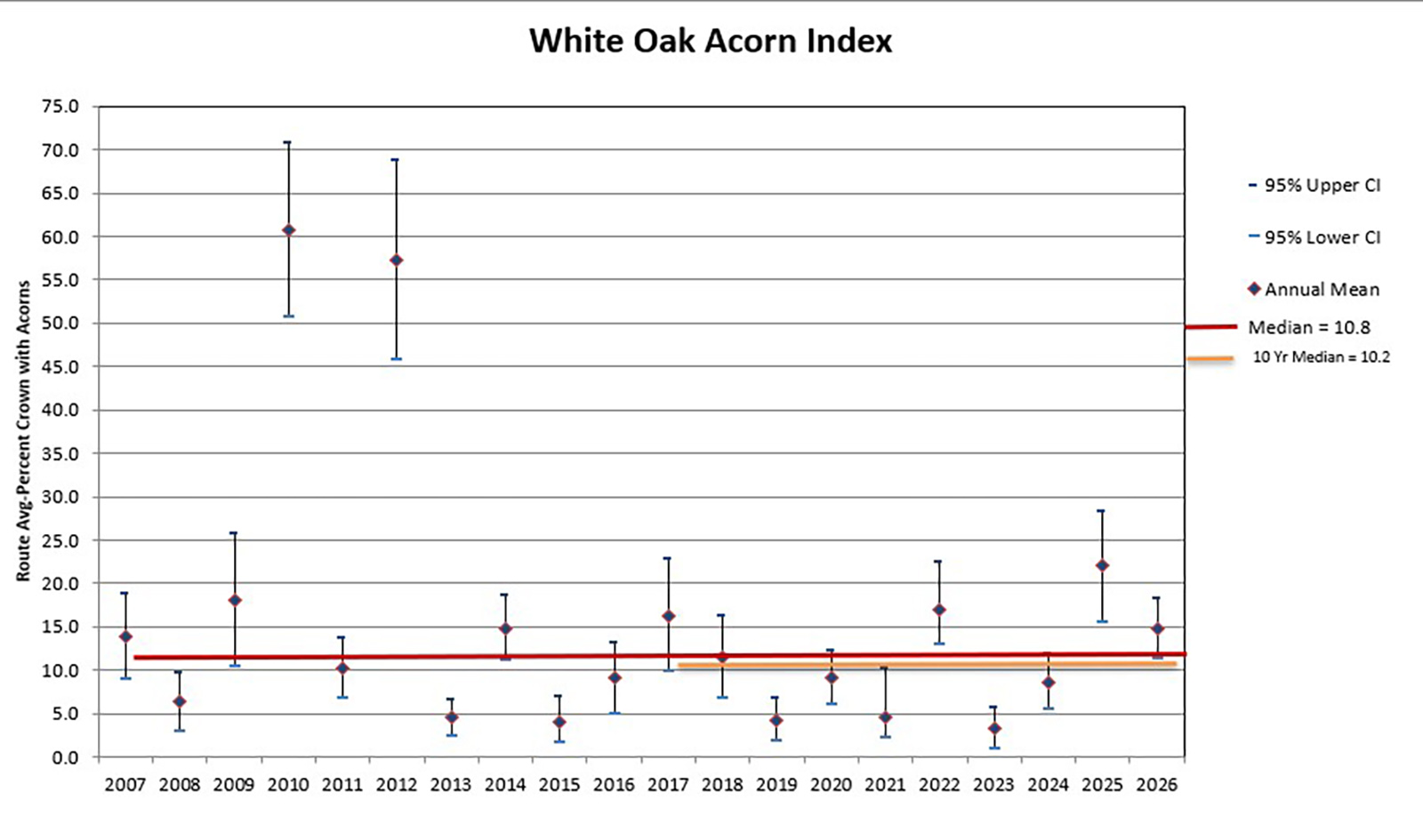
Statewide white oak acorn production (average percent of tree crowns with acorns), presented as long term median (2007-2026) with 95% confidence intervals.
Red oaks surveyed declined to below average (11.4) for the first time since 2022, following three years of above-average production. While 2026 fell below the long-term (19.5) and 10-year median (18.2), there were numerous trees reported with the “start” of acorns that should be ready for the fall of 2027. Red oak species take two years to fully mature an acorn, with the flowers forming in the spring of year one and the acorn maturing in year two. Barring significant weather or disease and insect issues; 2027 should be a better year for many red oaks in the survey.
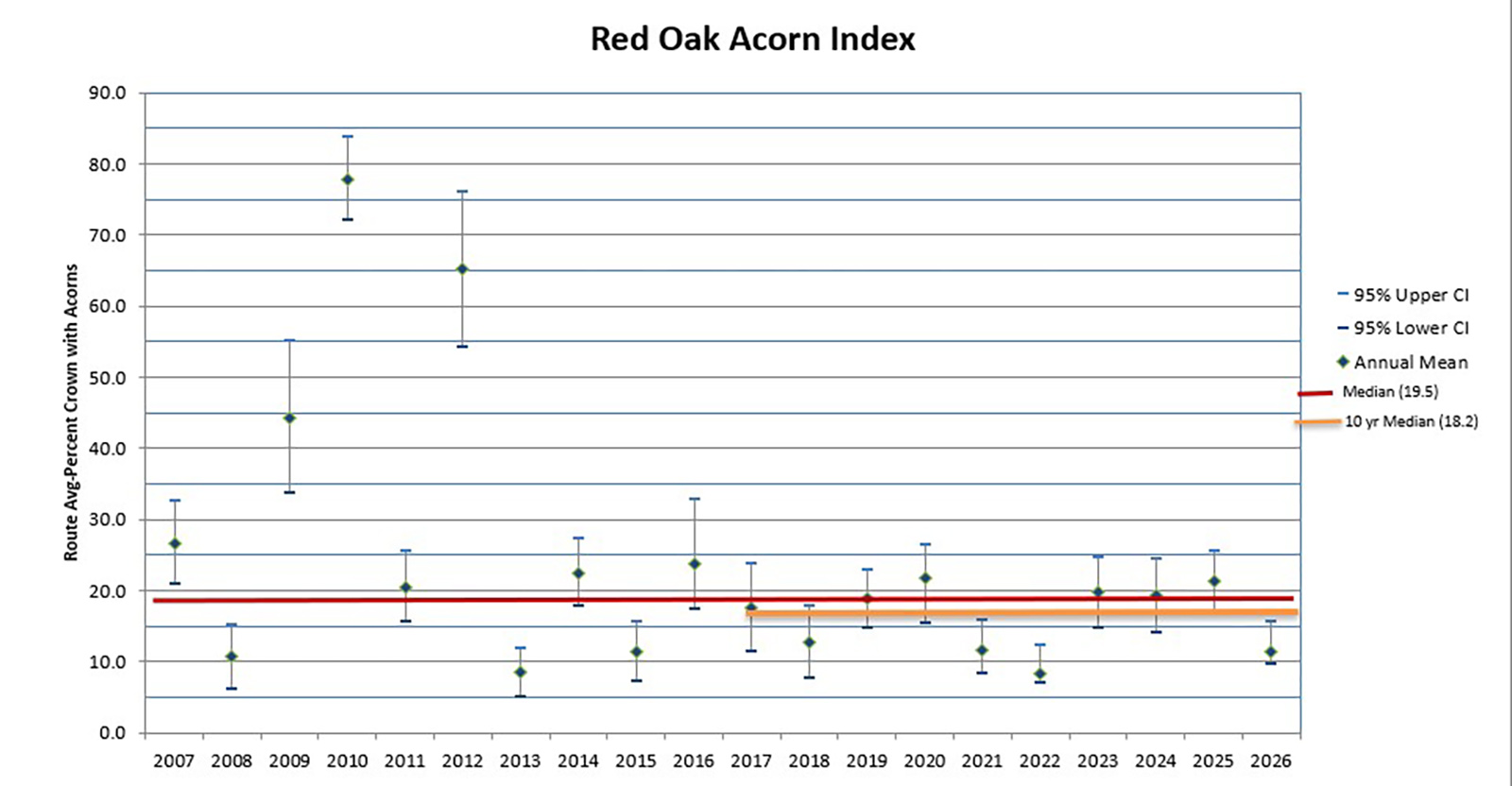
Statewide red oak acorn production (average percent of tree crowns with acorns), presented as long term median (2007-2026) with 95% confidence intervals.
White oak production was highly variable across the state with some routes reporting extremely low production, while others were average to above average. Interestingly, in nearly all routes there were single trees or groups of trees with above average production (50% or higher crown coverage). So, while a route as a whole may have produced poorly, there are certainly white oak acorns to be found across most parts of the state this year, at least in small pockets. High-elevation trees tended to report higher production, while low-elevation trees were typically below average. A majority of trees surveyed statewide did have at least minimal production this year (5-10% crown coverage), although chestnut oak was noted as having very poor to almost no production statewide. The best production was found in the Tidewater region, which currently has only one survey route, so results here may not be representative of the region as a whole. The Southern Piedmont had the highest route average (18) for 2026, but the Central Piedmont (15), Southern Mountain (14), and Central Mountains (14) were all close behind. The lowest production for the year was noted in the Northern Mountain region.
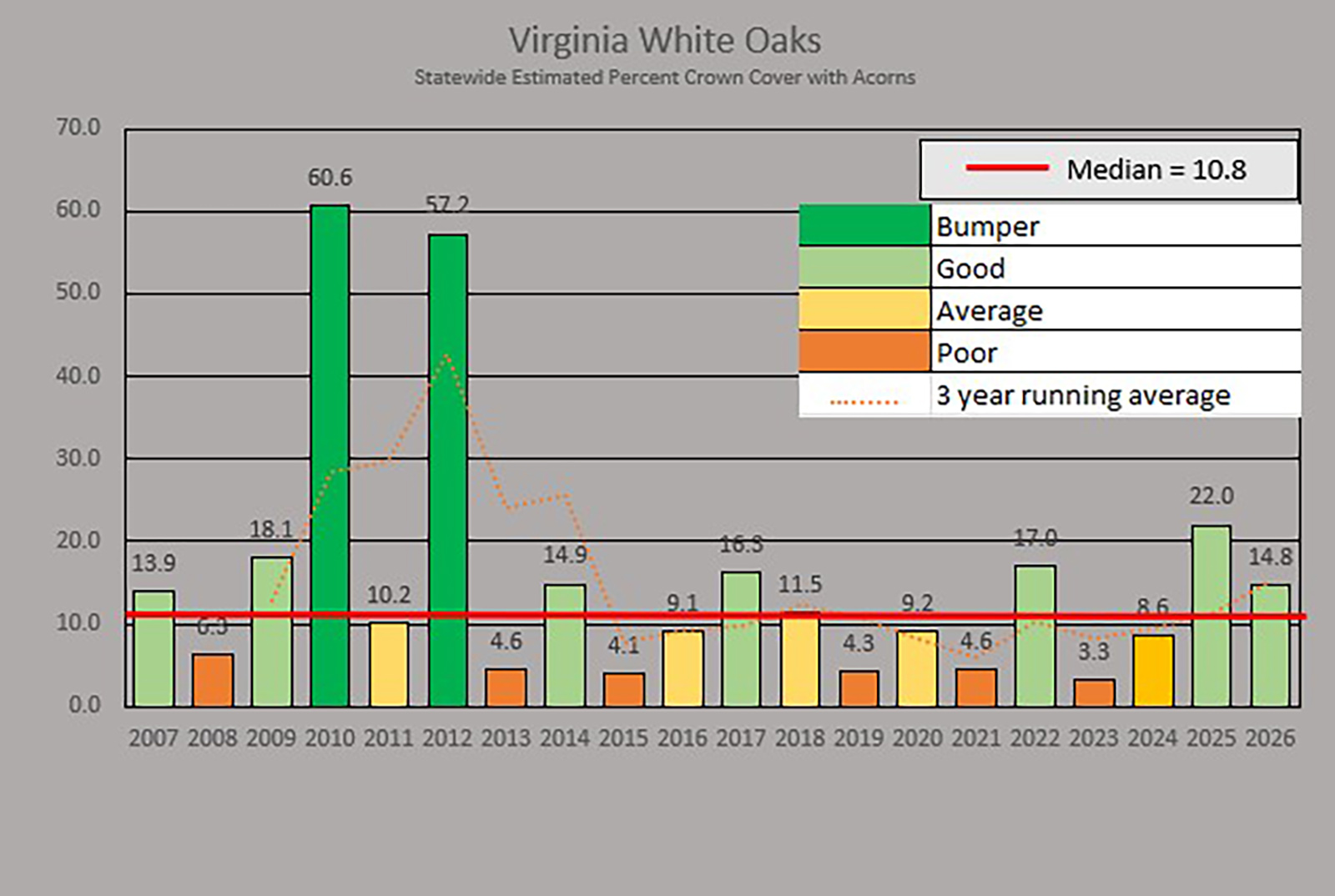
Statewide white oak acorn production (PCA) broken into categorical rankings based on 4 group cluster analysis with 95% confidence intervals.
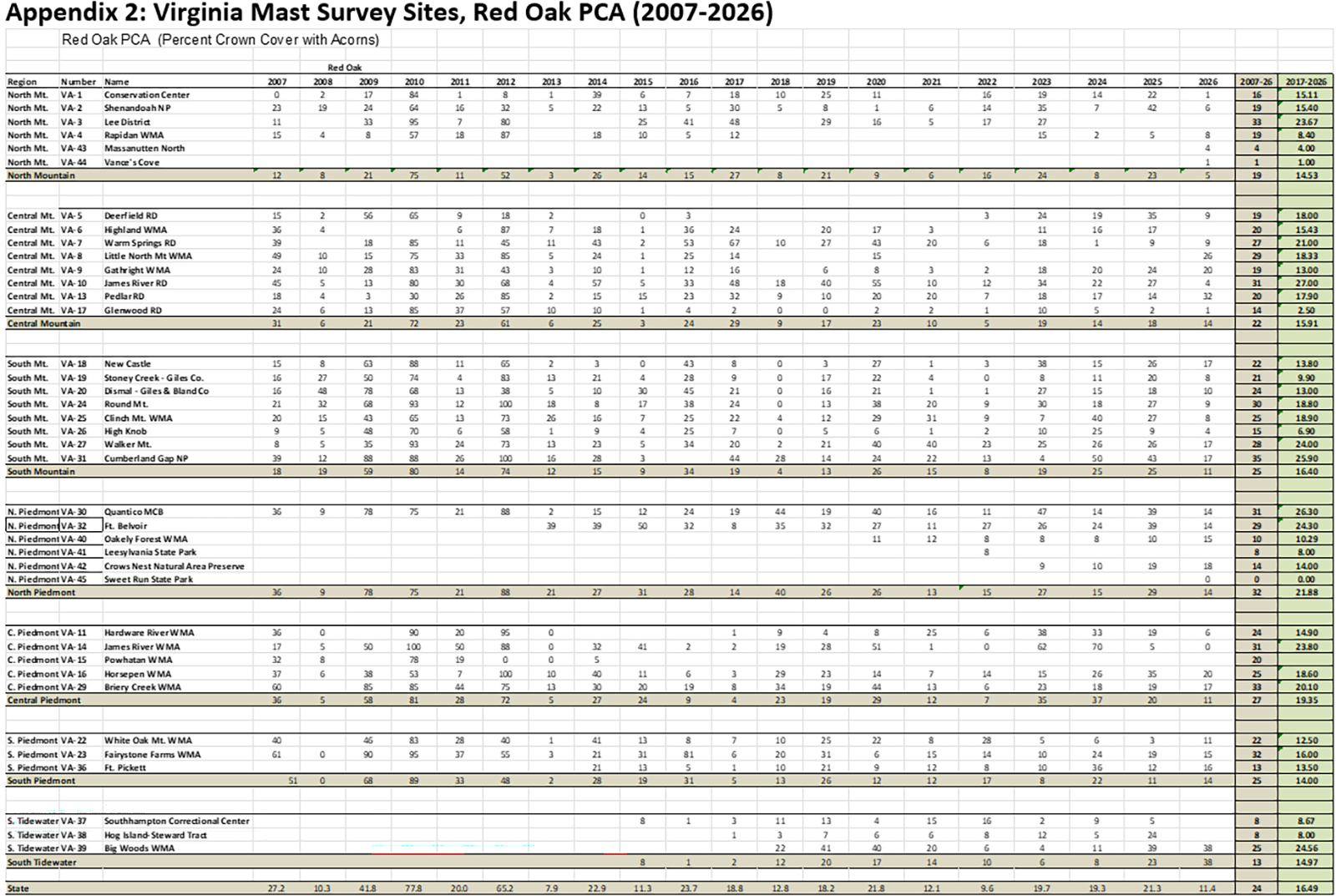
Red oak production was below average statewide with the exception of a few in the Central Mountains and Tidewater. While there were pockets of above-average red oak production, there were far more routes with the majority of red oaks reporting 0 to 5% coverage, equating to an almost complete failure for red oak production in 2026. Similar to the white oaks, the Tidewater region reported the highest production for 2026 (38), but is based on a single survey route. All other regions were fairly consistent, with below-average production of 11 or 14. The North Mountain region recorded the lowest production of 5, highlighting poor overall oak reproduction for the region this year. Statewide, northern red oaks were the only consistent producers across most routes, with other red oak species (black oak, scarlet oak, willow oak) recording very low to zero production. In the Tidewater and Southern Piedmont where southern red oaks are found, these were noted to be some of the most highly productive trees. While red oak acorns are not generally preferred by many wildlife species due to their tannin content (and size), in years of poor white oak production, these acorns will often be readily consumed, especially later in the season. Red oak acorns germinate the following spring, thus giving wildlife additional time to consume them before they sprout into a seedling.
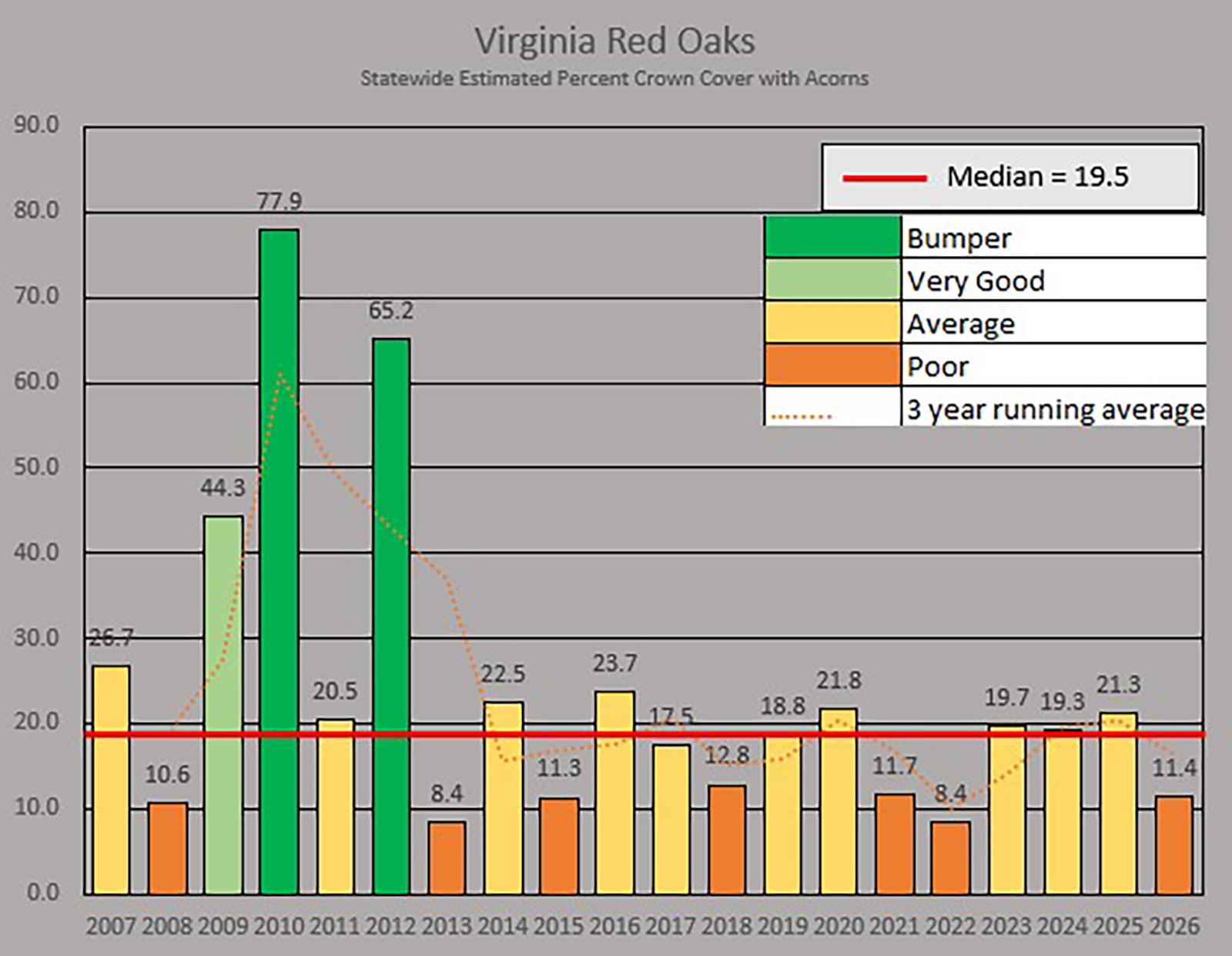
Statewide red oak acorn production (PCA) broken into categorical rankings based on 4 group cluster analysis with 95% confidence intervals.
As with all years, acorn production is highly variable and very site dependent. Both white and red oaks exhibited this variability in 2026 by having areas or even single trees with “good” mast production, while the majority of the route was poor or below average. This variability is due to many reasons (weather, insects, tree species), but for some of our survey sites we are probably approaching the biological end of production due to tree age. Unfortunately, finding “new” stands of mature oak in the 40-70 year age range is becoming more and more difficult due to aging forests and lack of sufficient regeneration. Most of Virginia experienced significant drought conditions this year, which began in the early summer and continued into the fall. Late spring freezes can also impact flower production and, coupled with growing season drought stress, can certainly impact both acorn production and when acorns begin falling. Many have observed acorns falling earlier this summer/fall than “normal,” which could be attributed to drought stress and the need for the tree to conserve resources.
The annual hard mast survey has been an ongoing effort between the Virginia Department of Wildlife Resources (DWR) and many partner agencies for many years. Many of the mountain survey sites have been in place since the 1950s. In 2026, staff from DWR, U.S. Forest Service (USFS), U.S. Fish and Wildlife Service (USFWS), Virginia Department of Conservation and Recreation (DCR)-State Parks, and DCR-Natural Heritage Program, Virginia Department of Forestry (DOF), U.S. Department of Defense/Department of Military Affairs, National Park Service (NPS), and Smithsonian Conservation Biology Institute (SCBI) surveyed 33 hard mast production sites across Virginia. Sites are located across all regions of the state, although a majority are currently found in the mountains. Continued efforts are being made to add sites to the Southern Piedmont and Tidewater areas.
Production by Region: White Oak (Appendix 1)
Production by Region: Red Oak (Appendix 2)
- Mountains: Red oak production was below average across all mountain regions and across nearly all individual routes. The only routes above average production were Little North Mountain WMA, Gathright WMA, and the Pedlar RD. The central mountain routes had the best production for the mountain region while the northern mountains reported the poorest production.
- Piedmont: Red oak production was below the long-term median in all three Piedmont zones surveyed, with only a single route (Horsepen WMA) noting average production. Production across all sites was fairly consistent, averaging around 15-18% crown coverage, although several Piedmont routes reported zero production route-wide (Sweet Run State Park, James River WMA). On a positive note, many sites noted the start of small acorns on many red oak trees, indicating the potential for above average production in the fall of 2027.
- Tidewater: The Tidewater region averaged well above the long-term median for the single site surveyed. Red oak production in this region can be highly variable, with southern red oaks typically dominating production. Willow oaks were noted to have limited to no production across the single survey site in 2026. We hope to add additional survey routes to this region in the future so that survey results are more representative of the region as a whole.
What does all of this mean for hunters and wildlife viewers for the fall of 2026? Due to the high variability of acorn production across many areas of the state, many wildlife species will likely be more mobile throughout the fall as they search for these pockets of high calorie foods. In areas where productivity is higher, movements may be more limited, at least during the early seasons when acorns are still abundant. Later in the fall and into the winter, the use of other food resources such as early successional habitats, food plots, and open agricultural areas may enhance visibility of many species although overall movements will likely be reduced as winter approaches. Secondary hard mast sources such as hickory, beech, and chestnuts (primarily Chinese chestnut) were in abundance across much of the state as were soft mast species such as blackberries, blueberries, pokeberry, wild grapes, paw-paws, persimmons, dogwood and black gum fruits. This means many wildlife species should be in excellent condition as they enter the winter after feasting on many of these food sources all fall.
Katie Martin is DWR’s Deer-Bear-Turkey Biologist.
Legal Disclaimer:
EIN Presswire provides this news content "as is" without warranty of any kind. We do not accept any responsibility or liability for the accuracy, content, images, videos, licenses, completeness, legality, or reliability of the information contained in this article. If you have any complaints or copyright issues related to this article, kindly contact the author above.
